Pages

11 tech integration tips to share with your school

Share these innovative tech integration tips with your team

tech-tipsEmbarking on a technology integration plan or beginning a technology pilot can be daunting. However, mapping out a clear path, being flexible, and communicating the stakeholders can help that plan be successful.
Jeff Downing, an elementary school computer specialist in California’s Fremont Unified School District, offered technology integration tips for administrators and teachers based on his experiences in his own school during a webinar for edWeb’s Digital Citizenship community.
Three years ago, Downing developed basic goals for his school, including providing every classroom with a high-quality projector, finding ways to give every student access to some type of technology each day, and increasing internet access.
At the start of the school year, every classroom in the school began with a high-quality widescreen projector, 62 iPads and 62 Chromebooks are onsite, every teacher will have a laptop, the school’s computer labs will offer 32 updated desktops, and internet access will have tripled.
“Now I feel that we can delve into using the tools and really incorporating digital citizenship into everything that we do,” he said.

Tips for ed-tech leaders
Barriers to integrating technology successfully include reluctant or resistant teachers, lack of resources, lack of time to learn technology, lack of trust in students and/or staff, outdated policies and procedures, and problems with infrastructure, Downing said.
Start with a purposeful plan, and create goals. Administrators should define where they want their school to go. Securing stakeholder buy-in from leadership, business, parents, and community groups is key, as is communication and consistent review and revision of the plan as needed. “Once you have a plan, you have to establish goals,” Downing said.
Expect and embrace failure. “If I’m not failing, I already knew it, so I’m not learning anything,” he said.
Don’t expect everyone to be at the same level when it comes to integration. Teachers will become comfortable with incorporating technology into their instructional practices at different speeds.
Lower the barriers to use. Students may benefit from training prior to using their technology in the classroom. Providing opportunities for immediate teacher and student success.
Set the example by using the tools you are encouraging others to use. Show educators how to achieve success by using the programs that your school or district has adopted.
Communicate, communicate, communicate. Everyone in the school and district should be on the same page when it comes to the technology integration plan and goals. Consistent communications allows the school community to feel connected, and it makes fundraising and awareness efforts that much easier.
Top tips for teachers

Teachers count lack of personal competence with technology, lack of time, fear of the unknown or fear of technology’s impact on teaching, lack of trust in students and self, and no time for troubleshooting among the top barriers to technology integration.
Try and use technology. Start small, with small groups, basic research, supplemental learning activities, and quizzes to check for understanding.
Treat the use of technology as you would planning any lesson. Teachers should teach explicitly and provide parameters for the technology’s use.
Teach digital citizenship by setting the example. Students will model the behavior their teacher displays, like checking a phone in class.
Unplug your lessons sometimes. Create a balance between the use of technology and turning the technology off. Unplugged lessons can be incredibly powerful. Downing often uses an unplugged lesson to teach his students about digital citizenship, and then follows it up the next day with a tech-focused lesson to reinforce the concept.
Give yourself “risk-free” opportunities. Have a growth mindset and don’t be afraid to fail. Tell students they are going to pilot a new lesson that day, and students will be enthusiastic while the teacher is able to try something new and gauge how the lesson works.
To view the archived webinar, visit the edWeb Digital Citizenship community.

8 free iPad apps to encourage creativity in young learners

Enhance creativity in young learners with these educator-selected apps

young-learnersEncouraging expression and creativity has never been easier, in an age where mobile devices let us combine music, art, and learning with the touch (or is that a tap?) of a button.
There are concerns, though, from fears that young children cannot distinguish what they are seeing from reality to eye strain and over stimulation, writes educator and mobile learning trainer Jonathan Nalder on the website Appitic.com. “But as new interactive screens in the form of iPads have entered many homes, the conventional wisdom around some of these has begun to change,” he continues, with new research diving into their positive benefits as well.
APPitic.com, an app resource site with more than 6,000 apps in more than 300 subcategories, offers a number of apps for young learners that differ from passive watching and dive into content creation and exploration.
Here, we’ve gathered a handful of those apps and you can access more on the APPitic site. All of these apps were originally curated by Apple Distinguished Educators.
1. Kids Musician
Kids Musician allows young children to play different instruments while learning more about music. Kids Musician is so easy to use and
features real instrument sounds, including pan flute, piano, and drums.
2. paintone
This app lets kids draw a picture and add a short sound clip to it for playback. Photos can be layered into creations as well.

3. RokLienz
Direct a music video featuring outer space aliens and a variety of songs in this free-to-play app that lets kids choose characters, settings, and accessories.
4. Color Me !!
A coloring booklet for children at the age of 2-6 years. Diverse pictures and color palette will trigger the development of a child’s imagination and shape his/her senses.
5. PBS KIDS Photo Factory
Put students in a photo with a favorite PBS Kids character in three simple steps, and share it with others.
6. Pic Collage
Combine photos, videos, fun fonts, stickers, and cute cutouts and arrange them by frames to create custom collages.
7. Thumpies Zero
Thumpies is a rhythm based music game for players of all ages. By correctly matching the beat of bouncing Thumpies, the player progresses through a song. If the player hits the targets in time, their Thump’o’meter slowly rises, but if the player misses or hits out of time, the meter falls.
8. Singing Fingers
Singing Fingers lets you fingerpaint with sound. Just touch the screen while you make a sound, and colorful paint appears. Touch the paint to play back the sound again.

9 handy apps every teacher should try

Try these offerings for assignment grading, classroom management, and more, which every teacher will love.

teacher-appsMany teachers love their mobile devices as much as their students — maybe more. And as our lives increasingly migrate to the digital world, it only makes sense that classroom organization will start going paperless to keep pace.
Some apps, naturally, are must-have for busy educators. APPitic.com, an app resource site with more than 6,000 apps in more than 300 subcategories, offers lots of apps for educators, from planners to helpful classroom tools and media creation.
Here, we’ve gathered a handful of those apps and you can access more on the APPitic site. All of these apps were originally curated by Apple Distinguished Educators.
Apps Gone Free
Find free apps using this aggregator that keeps track of new releases and purposely excludes paid offerings. Free
SlideShark
Show PowerPoint presentations right on the iPad — which can of course be ported to projectors with the right dongle — while preserving the same text, animations, and graphics. Free
storganeyes
Use this app to recall the contents of stacked boxes or bins and where they’re placed. A search function enables users to type in the name of the objects they are looking for and find their location. $1

SkipCount
A reminder app that works in the background. Countdown to any event and the app will remind you when it arrives, or give you an up-to-the-second countdown. Free
SlideShark
Show PowerPoint presentations right on the iPad — which can of course be ported to projectors with the right dongle — while preserving the same text, animations, and graphics. Free
Silent Light
Silent Light shows the decibel level in your learning space with an easy to understand traffic light system, which you can share on your projector or TV. Set optimum sound level goals to help students manage their own learning. $4
Socrative
A smart clicker and student response app that captures student results in real-time. Interact with the data to further student understanding in the moment, and review the reports to prepare for future classes. It will even aggregate and grade your pre-made activities. Free
GradeBook Pro
Record scores, attendance, behavior, and student performance in this app, which was designed with professional educators in mind. There are plenty of bells and whistles, like exporting options and data analysis. $20
Essay Grader
Designed to help standardize the essay grading process, this app lets teachers organize papers and select from lists of pre-written comments (or add their own) and guides them through each part of the essay, from thesis to conclusion. $6

Are schools really wasting money on computers?

The answer is complex — but here’s what the media and some schools get wrong

computers-schoolsDuring the past few years, I have closely followed the education studies published by the Organisation for Economic Cooperation and Development (OECD). Overall, I find great significance in their findings. However, I was discouraged when I saw recent news articles coming out of the OECD’s latest report on the use of computers in school. Headlines ranged from “Schools wasting money on computers for kids” to “Computers in schools don’t help kids learn.” After taking a close read of the report, I soon realized that these news articles missed the real message.
It is true that the OECD report shines a light on some of the limitations of technology use in education. For example, they note that, “technology is of little help in bridging the skills divide between advantaged and disadvantaged students.”
Taken alone, this statement might have led me to question whether the recent rise of technology integration in schools across the country is a smart idea. After all, like many educators, I have more than a passing interest in the subject. My school district has invested in Chromebooks, iPads, and a variety of teaching and learning software computers/devices/programs for students over the past three years leading up to our transformation to one-to-one.
But what the media glossed over is that the OECD report does not in fact recommend that schools start dumping their computers off at their local electronics recycling facility. It only suggests that more research is needed to fully understand next steps for educators, administrators, and policymakers. Importantly, the report suggests that the findings be cautiously interpreted, as developing students’ 21st century skills is more critical than ever, and we don’t want to stifle that effort. This is a far cry from saying that schools are wasting money on technology.

I strongly agree with the OECD’s recommendation that students must develop the 21st century skills necessary to effectively communicate, collaborate, think, and create as global citizens. As educators, this is what we are preparing our students to do. Technology supports students in reaching these goals, but tech alone has never been enough and it never will be. Students cannot achieve these goals without the support of a skilled teacher.
Research has consistently shown that teachers are the most important factor in how much a student will learn. The OECD report recognizes this with respect to education technology: “Technology can amplify great teaching, but great technology cannot replace poor teaching.” As such, it is imperative that we provide teachers with ongoing and relevant professional development to improve and refine their skills.
As in any profession, the expectations and use of new technology should be strategically delivered and not assumed. Professional development should continuously build teacher capacity in research-based teaching strategies and in their content. In particular, schools that are increasing access to technology should offer differentiated professional development that empowers teachers to integrate technology into pedagogy and build their capacity.
For the past four years, my district has been providing teachers with the requisite professional development for the successful integration of technology into pedagogy and content built on Harris, Mishra, and Koehler’s TPACK framework. The TPACK Framework provides a strong foundation for creating a clear understanding of the role of technology in teaching and learning. They advise beginning with lessons familiar to the teacher, and upgrading those activities using technology. I couldn’t agree more—this is a great, proven approach to successfully integrating technology.
Technology integration that is student-centered and evidenced based takes planning, training, collaboration, and time. We began slowly, offering afterschool drop-in sessions in the first year. In the second year, we began more formal learning opportunities including lunch and learns and in-service professional development. In year three, we provided teachers with their own laptops and built professional development sessions modeled after un-conferences, like Edcamps, where teachers engaged in peer-to-peer learning and sharing.
Importantly, we took time to work together before introducing these new models to students. Only now, after three-plus years of PD and training have we provided our students with Chromebooks. Today, we are continuing with our un-conferences, and are adding on additional opportunities for peer-to-peer learning and sharing. We are layering the integration of technology with a commitment to Deeper Learning, using Martinez and McGrath’s Deeper Learning Planning Guide as our frame.
I have been an educator for 22 years and currently serve as assistant superintendent for curriculum and instruction in my Rhode Island district. I have worked as a classroom teacher, as well as an administrator with expertise in technology integration. I have seen the amazing influence that research-based professional development (like the TPACK framework and Deeper Learning) can have in a school or district, to help teachers make the most of new investments, including curriculum, technology, or other instructional resources.
In my district, our teachers have been able to use technology to support problem-based learning, virtual fieldtrips, formative assessments (which help teachers understand what students know and what they’re struggling with in almost real-time), flipped classroom models, research, and intervention. Because of tech, teachers are transforming the teaching and learning experiences for their students, while increasing both relevance and rigor.
Technology can be exciting, and with that excitement, it is easy for me to understand why there is a misconception that technology alone has the capacity to improve educational outcomes. We must remember that technology is only a tool, and we cannot expect a tool to provide the panacea for all that is not working in education. Like anything else, overuse or over-reliance on technology will not lead to positive student outcomes. However, a failure to integrate technology into deeper learning will certainly place our students at a global disadvantage. As the OECD stresses in this latest report:
“Empowering young people to become full participants in today’s digital public space, equipping them with the codes and tools of their technology-rich world, and encouraging them to use online learning resources—all while exploring the use of digital technologies to enhance existing education processes…are goals that justify the introduction of technology into the classroom.”
With support, technology can assist teachers in transporting students to places previously unimaginable, challenging students with problems previously too complex, and sharing student successes with wider audiences than previously possible.
Paula Dillon is the assistant superintendent for curriculum and instruction in Barrington, R.I., and contributor to the Smarter Schools Project, a national forum highlighting the use of technology in schools.

The complete guide to picking the right device for every grade level

Ed-tech expert Kathy Schrock weighs in on mixed platform solutions for all grade levels

mixed-devicesA few years ago, many school districts jumped on the iPad bandwagon, when they were still brand new. The fact is they were easy to justify for a purchase of a shared cart since the Apple app store had so many wonderful applications for remediation, practice, and extension. These districts purchased the first iPad, which did not mirror and, believe it or not, had no built-in camera. Other districts waited for the second version to be released, which did have a camera and could be mirrored via Apple TV or the Reflector app, but only purchased the model with 16GB of RAM.
After a while, it became evident that maintaining a shared cart of iPads was no small feat. Taking care of the installation of apps and maintenance of the devices, as well as providing a positive experience for each shared user, was not easy. The 16GB of RAM was quickly eaten up by graphic-intensive apps, i-books, and PDF files, and the use of the camera for taking photos and videos. Schools began to think twice.
Enter the Chromebook, a device which was much cheaper and required little maintenance. However, even here there were difficulties at first as students needed to be attached to the internet to use the online Google tools and many of popular Flash-based sites were simply incompatible.
Fast forward to today and most of those bugs have worked themselves out. Devices have more memory and there are new features for both platforms that make them viable for use in the classroom. I truly believe a mix of devices is the best solution for schools.
The Apple App Store is full of well-vetted and useful software. When you hear “there is an app for that,” it seems to be true! From content-based applications that can be used for everything from remediation to enrichment, and apps that let students create videos, audios, simulations, infographics and more, the use of the iPad to support teaching and learning is truly remarkable. But the iPad really shines as a one-to-one device. Personalization, choice of apps and work that lives locally on the device make students feel connected with their iPad.
I recommend the Google Chromebook for a shared cart of devices. In conjunction with becoming a Google Apps for Education school or district, the Chromebook allows easy access to each user’s content. Since each student’s work lives in the cloud, and the Chromebook makes it easy for anyone with an account to log on to the device, it is perfect for a shared environment. There are now many extensions and HTML5-based online tools for the Chrome browser that allow students to do everything from editing images to using a math equation editor. And, the Chrome operating system now lets the student work on their Google Drive files when not connected to the Internet and syncs them up the next time they connect.
I also believe students of all ages need access to a full-featured computer. Stand-alone software, especially at the secondary level, provides students with the full-featured tools they need to create. For instance, Adobe Clip is a powerful iPad app that easily allows a student to create a video. But, for students that have the passion for movie-making, they need  to have access to the full version of Adobe Premiere.  In addition, access to a scanner, MIDI keyboard, powerful CAD and game-making software, a 3D printer, and any other computer-based hardware and software need to be available at point of need.

I also believe students of all ages need access to a full-featured computer. Stand-alone software, especially at the secondary level, provides students with the full-featured tools they need to create. For instance, Adobe Clip is a powerful iPad app that easily allows a student to create a video. But, for students that have the passion for movie-making, they need  to have access to the full version of Adobe Premiere.  In addition, access to a scanner, MIDI keyboard, powerful CAD and game-making software, a 3D printer, and any other computer-based hardware and software need to be available at point of need.
I am often asked about recommendations for devices at the various grade levels of PreK-12. Here are my current thoughts and rationale for my choices.
PreK-Grade 1
With the huge number of content-based iPad apps that can support the early learner, the iPad is the best choice for this grade level. There are also easy-to-use creation apps for this age group that can be used to showcase acquisition of content. A full-size iPad (with at least 64GB of RAM) cart in each classroom, with an AppleTV and a large wall-mounted TV or monitor would be my recommendation.
Grades 2-4
For these grades, full-size, 64GB iPad Mini carts for each classroom, with the addition of keyboards, would be my recommendation. The smaller iPad Minis fit nicely in a student’s work area and when collaborating in a group with others. Again, an AppleTV and large wall-mounted monitor should be included in the classroom.
Grades 5-8
For the middle school student, I recommend a one-to-one Chromebook initiative, with the devices going between home and school if possible. With the off-line availability of Google Drive, these students can put their time on the team bus or at the dentist to good use. I would also recommend a cart of 64GB full-size iPads for every two to three classrooms to allow these grade levels to use the iPads for the creation of projects and products as assessments. In the classroom, Reflector 2 software (airsquirrels.com) running on the teacher’s Mac or Windows computer would be a good solution for mirroring student iPads to the desktop and viewable via the projector.
Grades 9-12
I would love to see all high schools investing in a one-to-one laptop initiative. However, I know this option is not within the reach of every district’s budget. So, my recommendation would be the same as for grades five to eight– a Chromebook for each student and and multiple full-size 64GB iPad carts in each department, In addition, having an iPad cart in the library, so students can work on creative projects there, as well as having “blinged-out” computer stations available with the more robust software and hardware, can also help meet the needs of students. Again, the addition of Reflector 2 software on the teacher’s Windows or Mac desktop should be considered for mirroring the iPads.

Chromebooks dominate K-12 purchases

Latest quarter reveals that Chromebooks took 51 percent of K-12 market sales

chromebooks-salesChromebook sales have surged in the U.S. K-12 education market, with the devices now making up 51 percent of sales for the first time, according to a new report from Futuresource Consulting.
In the report, the consulting firm notes that the increase in Chromebook sales “has coincided with the need for districts to implement online assessment,” and that Chromebooks’ ease-of-use and traditionally low prices have helped increase sales.
[6 reasons Chromebooks are the device of the moment]
Despite the rapid sales growth in the U.S., sales across the rest of the globe are much slower. Chromebooks held 41 percent of sales in Canada, 9 percent in Finland, 9 percent in the U.K., and 1 percent in India.
The “OS competition” is only going to heat up, analysts predict.
“Chrome is the clear U.S. market leader now with over 50 percent of the K-12 OS market share, meaning Apple and Microsoft both have significant ground to make up. Microsoft is making strong moves, developing a partnership with Lightspeed to address device manageability, whilst bringing new devices to market which are likely to compete head on with Google in the key sub-$300 range. It will be interesting to see if Microsoft can halt the momentum Google has developed in the U.S. We envisage that the summer buying season in 2016 could be incredibly competitive with an OS price ‘war’ taking place,” said Mike Fisher, Associate Director of Education Technology with Futuresource Consulting.
More and more, school districts are choosing Chromebooks as they roll out one-to-one initiatives in their schools.
IT leaders in Virginia’s Chesterfield County Public Schools opted for Chromebooks based on their cost, network capacity to support the devices, and the devices’ short boot-up time.
The district was hoping to expand learning outside of classroom walls and school hours, said Lyle Evans, the district’s assistant superintendent, human resources & administrative services.

3 barriers, 3 fixes for school broadband

A new report urges state leaders to help all school districts access high-speed school broadband

school-broadbandNationwide, 23 percent of school districts still do not meet the Federal Communication Commission’s (FCC) minimum school broadband access goal of 100 kbps per student, according to a state-by-state broadband connectivity report from the nonprofit EducationSuperHighway.
The top three barriers to meeting the FCC’s minimum school broadband goal, according to the report, include:
  • Access to fiber: School districts without fiber are 15 percent less likely to meet connectivity goals.
  • Broadband affordability: Districts that do meet the 100 kpbs per student minimum pay an average cost of $5.07 per Mbps–those that do not meet the goal pay more than double, at $12.33 per Mbps.
  • School district budgets: The average internet access budget in districts that meet the FCC’s connectivity goal is $4.93 per student–more than 2.4 times the $2.08 per student budget for districts that do not meet the school broadband connectivity goals.
In all, 20 million more students have been connected to high-speed broadband over the past 2 years, according to the report. In 2013, just 30 percent of school districts met the Federal Communication Commission’s minimum school broadband access goal. In 2015, that jumped to 77 percent.

Despite meeting connectivity goals, most districts still have to increase the amount of broadband they purchase in order to keep up with demand, which is growing in K-12 schools at a rate of more than 50 percent per year, EducationSuperHighway says. In fact, the typical school district will have to triple its bandwidth in the next three years.
Three things can help connect all of the nation’s students to school broadband:
  • Connect 9,500 schools to fiber: Twelve percent of schools that need a fiber connection do not have one, and EducationSuperHighway estimates it will cost roughly $1 billion to achieve connectivity.
  • Ensure every classroom has wi-fi: Districts can leverage the $3.4 billion in funding available for internal connections over the next four years to ensure every classroom has wi-fi.
  • Make school broadband affordable: Continually focusing on affordability, and striving to lower the cost of broadband access to $3 per Mbps, would help 12.2 million students meet the FCC’s minimum access goal. If remaining districts invest $0.25 per student per year, every student would be able to meet the FCC’s minimum goal.
“Digital learning has the power to transform education in this country, but that can’t happen without
first connecting all of our students to high-speed Internet. By working together to put a broadband
foundation in place, we can ensure that every student, in every state has equal opportunity for a world-class education,” said Evan Marwell, CEO of EducationSuperHighway, in a press release about the report.
To access information about your specific state, click here for a list of all states, and click here for an interactive tool.

How to save money and time with asset management software

Asset management software is keeping track of textbooks and more for districts

textbooks-assetsTwo years ago Consolidated Unit School District 300 in Algonquin, Ill., was facing a pretty daunting challenge across its 26 schools. When it came to recording the inventory of assets like textbooks, some of the district’s numbers were incorrect. “We’d start a new school year thinking that we had the appropriate supplies for our students, only to find out that our inventory system didn’t reflect what we actually had on hand,” said Susan Harkin, chief operating officer for the 26-school, 21,000-student district.
A student who wasn’t matched up with an algebra book, for example, would often have to wait a week or two for it to be ordered and delivered to the classroom. And for some of the outdated books that are no longer being published, the district could spend months trying to hunt down the textbooks. “Students would start the school year without a textbook to refer to for homework,” said Harkin. “It wasn’t a good situation for a district that’s focused on student success.”
Harkin says the schools’ curriculum and instructional personnel were particularly concerned about the gaps that existed between the inventory system and the actual inventory. At the time, D300 was most concerned about textbooks, although it also wanted to improve the tracking of district-owned assets such as tablet computers and musical instruments.
Finances were another driver, says Harkin, who notes that her district spends $2,500 less than the state average per student. “Assets and resources are tight,” she added, “so everyone wants to do his or her part in helping to make sure we’re using our resources efficiently and effectively.”
A district-wide initiative
asset-managementWhile searching for a solution to its asset management problem, the district found one possible answer right in its own educational technology stable. Already using Follett Learning’s Destiny Resource Manager, the district started leveraging the platform’s physical inventory capabilities. Using the web-based system, teachers and administrators can view current inventory levels and locations, manage the inventory, and more efficiently plan for resource expenditures. They can also reallocate assets to different schools, thus reducing redundancies and stockouts.
Harkin’s team began by conducting a complete asset inventory. The process was handled by a dedicated team of staff members for whom “the management and movement of those assets” were part of their part of their job duties, she said. Finally, the district installed a new staff person to oversee asset management from the central office and coordinate the process across D300’s 26 schools.
As a component of the physical inventorying process, D300 weeded out books that weren’t part of its curriculum. “Why track assets that don’t matter to us anymore?” Harkin asked. In addition, the district shifted its textbook ownership philosophy from “building level” to “district level.” Because textbooks are now a district item, if a building has an overstock of 100 books, those assets can more easily be moved to another school as needed.
On the financial side, Harkin estimates that the district saves “a couple hundred thousand dollars per year now,” with most of the savings coming from its ability to more accurately track assets across its schools. In the past, for example, institutions with growing enrollment numbers would simply buy textbooks, not knowing that another school with declining enrollment numbers had the needed assets sitting in its storeroom.
“In the past, schools would hold onto them because they already paid for the books and didn’t want to give them up,” said Harkin. “By taking ownership across all of our schools, we’ve been able to make asset management a true, district-wide initiative that everyone is now onboard with.”
No more paper and faxing
With 230 schools and over 150,000 students, Dallas Independent School District relied on an antiquated asset management system that resided at the district office and accommodated just four user logins. When they needed textbooks, teachers would have to fill out handwritten forms and fax them to the office, where someone else would input the information and place the order. And while the previous system was used to maintain inventory, the fact that only four people could access it made it cumbersome and far from collaborative.

“We needed a new solution to bring us into the modern times,” said Matt Tyner, manager of textbook services.

Other asset management challenges plaguing the district included a lack of system data, no automation, and low visibility over textbook inventory across its many campuses. “My predecessor had been here for 25 years, so when I came onboard in 2011 it was definitely time to automate and streamline these largely manual processes,” Tyner said.
After putting out a request for proposal (RFP) that attracted bids from two different software vendors, Dallas ISD decided to implement a textbook inventory management solution from Hayes Software Systems. Key criteria included a system that would provide the district with real-time data and that would offer a district-wide platform that all parties could use via any internet-enabled device or computer. “We needed something that would replace the phone calls we were getting on every single issue and question,” said Tyner.
Functional capabilities
Dallas ISD’s textbook inventory management solution handles functions like the requisition of instructional materials, the return of instructional materials to the warehouse, campus textbook inventory, a repository for lost and used books, and an easy way to transfer materials among campuses. All of the activities take place online and can be access 24/7 on an as-needed basis.
According to Tyner, the system has helped the district improve its inventory tracking and real-time accountability — two things that were largely handled on a manual basis before 2011. “Our teachers and principals really had to jump through hoops to find their books, write up their orders, fax them in, and then monitor the order progress,” said Tyner. “This is just a much simpler way to get all of that done.”
To districts that are struggling to get a handle on their school-owned assets, Harkin said the first step is simply admitting that this is one of the “hidden issues” that isn’t always talked about or discussed — but it does exist and can be both expensive and time consuming. “If you really want to be responsible with your textbooks, you have to admit that you have a problem and that you’re willing to tackle it collectively,” she said. “It may require an initial investment in time and money, but if you keep ignoring the problem it’s only going to get worse.”
Bridget McCrea is a contributing writer for eSchool News.

Alabama district eyes digital conversion by eliminating textbooks

District’s digital conversion is an attempt to help prepare students for the world in which they’ll work, school board members say

digital-conversionDecatur City Schools in Alabama is considering a digital conversion that would significantly change how the district delivers education and communicates with parents.
The plan would eliminate textbooks, provide each student a personalized approach to learning, give them 24-hour access to the classroom and eliminate the assignment gap by assigning tasks appropriate for each student’s learning level.
DCS would not be the first school district in the nation to take a total digital approach to learning, but school leaders said they want to be a model for the state in the way Mooresville Graded School District in North Carolina became one for the nation.
“We can do this, and if we don’t, we’re cheating our students by not preparing them to be competitive in a global society,” Walter Jackson Elementary Principal Rhonda Reece said.
Reece serves on an 11-member committee that started meeting in August at the request of Superintendent Ed Nichols. The group, which includes administrators, parents and Central Office employees, rolled out its proposal last week.
If successful, DCS, by 2018, will eliminate teachers leading lessons from textbooks for a model that will include student-directed learning, which relies heavily on digital material.
The plan is ambitious, but it is one committee members and parents Mary Ila Ward and Lorrianne Curtis Sparkman said is achievable before 2018.
“This is where our students are, and the good thing about this proposal is it allows them to customize their learning plan,” Ward said.
The first key step, DCS director of technology Kathy Rains said, is school board buy-in, something the committee didn’t overwhelmingly get last week


Board President Karen Duke questioned Rains about how the district would serve parents without internet access, and board member Joe Propst quizzed her about making sure every home has a computer.
The committee put several proposals on the table, including talking with providers about discounted Internet access packages for DCS students and offering free Wi-Fi citywide and opening schools to parents.
“This will be a community focus,” Rains said.
As for providing computers, Chief Financial Officer Melanie Maples said the district will continue to implement its technology plan, which includes providing a computer for every student by 2018.
Rains said the school system will hire an outside company to do a “gap analysis” to determine what infrastructure needs to be in place to execute the digital conversion plan.
She said several school officials also plan to visit the Mooresville Graded School District in January. That district started its digital conversion in 2007, and has become an international model.
In 2013, President Barack Obama introduced his ConnectED program at Mooresville. The president wants to connect 99 percent of schools to high-speed broadband Internet by 2018.
Mooresville used the savings from eliminating more than 30 teachers to fund its digital conversion.
Huntsville City Schools rolled out its digital conversion plan in 2012, and put laptops in the hands of more than 22,000 students. There were some problems, such as the lack of bandwidth to download certain textbooks.
But despite an outcry from some parents to return to standard textbooks, Huntsville school officials stayed with their plan, and the district’s standardized test scores have surpassed those of DCS.
“Do you think Huntsville’s scores rose because of digital conversion?” Dukes asked.
“Yes,” Rains answered.
Nichols said teachers will remain in the classroom to reinforce learning.
Board member Donnie Lane said he is behind the concept “because if we don’t, kids coming to work will not be qualified for jobs. This is where they are learning.”
Rains said Mooresville — a district of about 6,000 students and ranked 96th among 115 North Carolina school districts in terms of spending per student — took about three years to work out its kinks.
According to the system’s website, the new teaching method requires more dialogue and discussion among students, and students are required to participate.
Rains said DCS already is doing some of the things Mooresville does, such as providing students access to computers.
“We’re not ready for this tomorrow, but I think this is the future,” she said.
Sparkman, who is president of the citywide Parent Teacher Association, said there are some benchmarks that will indicate when DCS has gone through digital conversion.
The obvious is there will be no textbooks, but she said the paperwork used to communicate with parents, and to evaluate principals and teachers, will be a thing of the past.
Sparkman said every school will have instructional coaches in place, and students will have digital portfolios.
“We want this to be a state and national model,” she said.
Rains believes in the program, but she wants the district to have community meetings so DCS can get parental buy-in.
“We have to explain to them why our students need this,” she said. “This is just the beginning. We have a lot of work to do.”

Every Student Succeeds Act shifts more power to states

Much-anticipated bill attempts to satisfy all stakeholder groups as it moves away from NCLB mandates

every-student-succeedsWhile a “new and improved” version of the hotly-debated No Child Left Behind Act (NCLB) would still require reading and math testing in grades 3-8 and once in high school, states would have much more leeway when it comes to defining teaching and learning objectives and outlining accountability measures.
The Every Student Succeeds Act gives states the power to determine their own academic goals and measure progress toward those goals–a departure from NCLB, which aimed for 100 percent math and reading proficiency by 2014.
States or districts will be in charge of determining how to improve persistently underperforming schools. Previously, NCLB gave the federal government a strong voice in what happened to those schools. Now, under Every Student Succeeds, schools requiring much intervention would be among the lowest-performing 5 percent in the state.
Every Student Succeeds also prohibits the U.S. Department of Education from providing incentives for participation in the Common Core State Standards.
Reaction to the bill came quickly, with critics worrying that states will have too much leeway and too little accountability. Supporters’ statements echoed the sentiment that a change has been a long time coming.

Education technology stakeholders and advocacy groups applauded the legislation’s mention of technology and digital learning.
“ESEA has been in need of revision for many years, as the education landscape has evolved dramatically since it was last updated 15 years ago,” said Mark MacCarthy, SIIA senior vice president of public policy, in a statement.
“This legislation represents a renewed, long-awaited commitment to digital equity. It will strengthen the technology competencies of educators, including their data privacy know-how, and give more students the tools needed for success in college and career preparation,” CoSN CEo Keith Krueger said.
“Far too many educators lack the 21st century training to enhance teaching and learning through technology. Innovations and educational practices have simply outpaced federal law and investment, leaving poor communities behind the digital curve.”
“SIIA is particularly supportive of the renewed effort by policymakers to fund vital education technology. The ITECH program included in the ESSA will support schools as they seek to bring classrooms into the 21st century through enhanced access to technology and strong pedagogical skills for educators.”
The National Governors Association issued a full endorsement of the bill–a move it has not taken in almost 20 years.
“This is a significant step in the right direction in our work to ensure state control of education policy. This bill reinforces that accountability and responsibility for K-12 education rests with the states,” said NGA Chair Utah Gov. Gary R. Herbert in a statement.
In a joint statement, American Association of School Librarians (AASL) President Leslie Preddy and American Library Association (ALA) President Sari Feldman expressed their appreciation that the legislation recognizes the role school libraries play in students’ success.
“School libraries are learning hubs where students become motivated readers and actively engage with technologies and the latest information resources, preparing them to succeed in our global, competitive economy and the ever-evolving workplace. School librarians are instructional leaders and essential partners with all teachers, collaborating to meet diverse needs, strengthen student learning, and facilitate deeper understanding of print and digital materials,” they said.
“Students have suffered long enough under the broken system of test and punish created by the No Child Left Behind Act,” NEA President Lily Eskelsen García said.
“In particular, the bill includes student and school supports in state accountability plans to create an opportunity ‘dashboard’; reduces the amount of standardized testing in schools and decouples high-stakes decision making and statewide standardized tests; and ensures that educators’ voices are part of decision making at the federal, state and local levels.”
A final version of the bill was released on Nov. 30. Congress is expected to vote on the bill in the coming weeks, and President Obama is likely to sign it by the end of the year.

New grant will provide active learning spaces to schools

Steelcase Education grant leverages classroom space to implement new teaching practices

active-learningSteelcase Education on Dec. 1 launched the second annual Active Learning Center (ALC) Grant, a program to provide active learning spaces to schools across North America. Applications are being accepted online through February 12, 2016.
The ALC grant program leverages classroom space to implement new teaching practices, centering on student focus and collaboration. Up to 15 grant recipients will have the opportunity to install one of four learning environments featuring Steelcase Education’s state-of-the-art furniture and technology.
“Research has shown that active learning environments positively impact student engagement,” said Sean Corcorran, General Manager of Steelcase Education. “Our 2015 grant recipients have already seen improvements in student focus, and we are eager to partner with more educators who are committed to providing inspiring environments in order to enhance student learning.”
New this year, technical and trade schools are eligible to apply for the ALC grant, in addition to grades six through twelve, colleges and universities. Schools are also permitted to submit applications for library and media center spaces this year. Steelcase Education will award up to 15 schools with a new classroom, valued at $62,000.
Applicants to the program are asked to describe the desired pedagogy they plan to employ and how the new active learning classroom will positively impact teaching and learning. Grantees will be selected based on their commitment to active learning strategies and how they plan to measure student success and share their learnings with the broader education community.
As part of the ALC program, grantees receive training from Steelcase leaders on best practices for the new technology and furniture. Grantees will also participate in a community of practice with fellow grant recipients to share insights and best practices.
Last year’s program garnered over 500 applicants and twelve recipients from North America. All classrooms have been installed and are being used by teachers and students. Grantees included P.K. Yonge Developmental Research School at the University of Florida, Ohio State University, the University of Arizona and Forest Hills Northern High School in Grand Rapids, MI. Research from the inaugural group of ALC grant recipients is underway and will be released in 2016. More information on the 2015 Active Learning Classroom Grant can be found here.
“We are honored to be part of the inaugural class of ALC grant recipients,” said Dr. Lynda Hayes, director and university school professor at P.K. Yonge Developmental Research School at the University of Florida. “Our new classroom allows us to support students in a variety of learning and teaching styles that encourage flexibility and movement and positively impact the dynamic between teachers and students.”
Winners of this year’s grant will be announced in March 2016.
Material from a press release was used in this report.

Students break single-venue learning world record


learning-record
Students designing in 3D on Makers Empire in one of the classrooms at Baptist Rainbow Primary School.
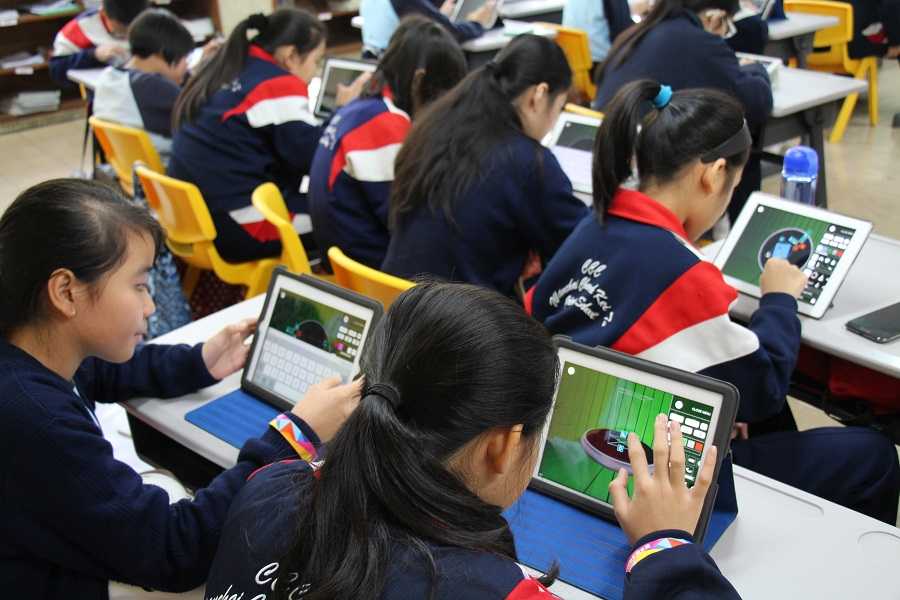
After many months of planning, more than 900 students from more than 50 schools gathered at Baptist Rainbow Primary School in a new Guinness World Record for the greatest number of people attending and participating in a software lesson at a single venue.
The Guinness World Record event was organized by The Association of IT Leaders in Education (AiTLE) in conjunction with Baptist Rainbow Primary School, DTSL and Makers Empire.
Students arrived on Saturday morning and went to their allocated classrooms for the event. Each student was recorded and given a wrist band with official nominated stewards and witnesses present. The school’s internet broadband was upgraded especially for the event, with each classroom fitted with video and audio communication and wifi infrastructure by Cypher Martin.
Students from kindergarten to secondary school and technical colleges were then taught simultaneously the importance of “water” to mankind with presentations from Erwin Huang, Kenneth Lo (The Hong Kong Polytechnic University) sharing the University’s student projects with communities in Cambodia. To nurture students’ creativity, students were then led through a 3D design lesson using Makers Empire 3D design software by Lap Leung, Makers Empire co-founder, and Chris Leung, DTSL Marketing Director.
To celebrate the schools and students participation in the Guinness World Record breaking event lucky draw prizes of a Tiertime 3D printer, Tinkerine 3D Printer and Makers Empire 3D Printing Learning Program for schools along with DTSL professional installation and training services were awarded. Each participating student and volunteer received a commemorative 3D printed souvenir medal sponsored by DTSL.
AiTLE Chair Albert Wong said “There are many people in the world who are not able to receive drinking water ever day but with advances in technology, solutions utilizing 3D design and 3D printing are simpler than ever before to help solve problems related to efficient and effective use of water resources. AiTLE would like to thank all the participating schools, partners, sponsors, all of the witnesses, stewards, volunteers, parents and students for all their hard work and efforts in making this event possible.”
“The community of Hong Kong is uniquely placed to share its experience and learnings with its large dense population and limited water resources. Over many years they have carefully managed effective water usage. Students at The Hong Kong Polytechnic University have also undertaken projects that have assisted less fortunate communities in Cambodia sharing their knowledge and skills to help improve their quality of life.”
Baptist Rainbow Primary School Principal Chu said “We want our kids to look at the world and say, ‘These are problems that need to be solved. We can use our creativity to solve those problems to make the world a better place’.”
DTSL Business Director Jack Wu said, “This record breaking event demonstrated that schools and students have no limit to their creativity and innovation. In using the latest 3D printing tools schools and students in Hong Kong can be confident that they are either staying ahead or keeping in step with their peers abroad.”
Roland Peddie, co-founder CTO Makers Empire said, “It was fantastic to see so many different schools and students designing in 3D on Makers Empire 3D design software whether they choose to use their iPads, Android, Windows or Mac devices. The Guinness World Record breaking event reinforced the support we have in place for the diverse school learning environments and infrastructure requirements we see in schools and districts.”
Lap Leung, co-founder Makers Empire said, “What an event! Students will be able to remember this Guinness World Record breaking event for the rest of their lives. More importantly, through 3D design and 3D printing, they develop design thinking principles along with critical analysis and problem solving capabilities. To have students from kindergarten participating and designing in 3D is simply amazing!”
Material from a press release was used in this report.

Learning Upgrade launches interactive whiteboard courses

New Teacher Upgrade math and ELA lessons combine a front-of-class solution with individual instruction using songs, videos, and games

whiteboard-coursesLearning Upgrade has launched new whiteboard courses to provide a whole-class solution that makes lessons convenient, rigorous, and collaborative for teachers.
Teacher Upgrade courses offer a new way for teachers to engage with an entire class of students through interactive, whole-class activities accompanied by differentiated individual lessons. Each Teacher Upgrade lesson incorporates exciting songs, videos, and games that engage even the most reluctant students.
Teachers play the lessons using a computer and a data projector or interactive whiteboard, such as a Smart Board or Promethean board. Students solve problems by pressing buttons or moving objects on the screen with a pen or finger.
With more than 500 standards-aligned lessons that support student mastery, educators can easily launch Teacher Upgrade from the “students” or “courses” tab on their teacher dashboard. With quick access to high quality lessons that cover every standard, teachers are able to avoid searching for content and focus more time on effective teaching.
Teacher Upgrade includes every lesson from Math Upgrade K–8, Pre-Algebra, and Algebra; as well as English Upgrade 1–5, Reading Upgrade, and Comprehension Upgrade courses.
“Teachers have asked for a simple way to access all of our musical lessons for whole-class instruction. We are excited to offer Teacher Upgrade to meet their needs,” said Vinod Lobo, co-founder and CEO of Learning Upgrade. “Providing teachers with rigorous lessons that engage all levels of learning abilities and styles is paramount. The new Teacher Upgrade lessons are a great way to help a wide variety of students—including special needs students and English learners—reach mastery at their grade level.”
For more information about Learning Upgrade, or to register for complimentary access to all of their resources, visit them online at www.learningupgrade.com.
Material from a press release was used in this report.

Should schools count coding as math?

California officials make push for universities to accept high school coding as a math class

computer-scienceBacked by an all-star cast of Silicon Valley executives and nonprofit leaders, Lt. Gov. Gavin Newsom asked the University of California Academic Senate on Dec. 2 to count high school computer science classes as math classes instead of electives — a move supporters say could help to diversify the tech industry.
Newsom’s hope is that the shift will encourage California high schools — which frequently tailor their curriculum to reflect what the UC system requires — to beef up their computer science offerings.
Turning computer science into a core requirement could eventually pull more women and people of color into those classes at a younger age, and help diversify the talent pool in an industry dominated by whites, Asians and men.
Last year, fewer than 9,000 California high school students took the AP Computer Science exam, according to Newsom’s office. A little more than one quarter were women, fewer than 1,000 were Latino, and only 148 were African American.
“Every student learns about photosynthesis and fractions even if they don’t grow up to become botanists or mathematicians,” the former San Francisco mayor wrote in a letter to the Academic Senate’s Board of Admissions and Relations with Schools Committee. “A basic understanding of computing and computer science is foundational to many fields and will prepare students both for college and for the careers of tomorrow.”
Salesforce.com CEO Marc Benioff, Twitter CEO Jack Dorsey, Facebook executive Sheryl Sandberg, Y Combinator President Sam Altman, LinkedIn Chairman Reid Hoffman and venture capitalist Vinod Khosla were among two dozen tech leaders who signed the letter. Also backing it were San Francisco Unified School District Superintendent Richard Carranza and Oakland Unified School District Superintendent Antwan Wilson.
Michael Nobleza, the national director for Oakland’s Yes We Code, a tech skills training program for low-opportunity young people, said this proposal would “help broaden the pipeline” by introducing more students to computer sciences.
“Only those who are drawn to computer sciences — who are usually white and Asian students, because they see themselves succeeding in it — are taking them,” Nobleza said Dec. 2 after reviewing Newsom’s letter. “Overall this could bring in more students of color.”
UC already does “consider some computer sciences classes as meeting the math requirement,” university spokeswoman Dianne Klein said Wednesday after reviewing Newsom’s letter. “Others, that do not have sufficient math, are considered electives.”
She pointed to the system’s admission requirements, which say that “a computer science course with primary focus on coding methods alone would not fulfill the mathematics requirement, whereas one with substantial mathematical content (e.g., mathematical induction, proof techniques or other topics from discrete mathematics) could satisfy the requirement.”
©2015 the San Francisco Chronicle. Visit the San Francisco Chronicle at www.sfgate.com. Distributed by Tribune Content Agency, LLC.

Virtual platform targets global education

The new online education and creativity platform delivers live, online courses in the areas of language, arts, music, and STEM

global-educationA new virtual classroom education platform from Coolcher offers online classes taught by teachers from around the world.
The classes can be scheduled to fit with any school’s calendar. For a one-time fee, schools and after-school centers get access to all courses for an unlimited number of classes for one year, giving students the opportunity to enjoy unique courses, and interact live with not just the teacher, but also with their peers from around the country.
“We created Coolcher as parents who were looking for courses that help our daughter learn more about her heritage, but were unsuccessful in finding anything,” said Jatin Grover, the founder of Coolcher. “With this new platform, we hope to bring the whole world to kids around the U.S.—a whole world of new and unique subjects, and a whole world of new cultures.”
The platform also connects homeschoolers with other students and homeschoolers who are taking the classes at the same time. The virtual classroom environment gives homeschoolers a connection with more students, bringing with it enhanced collective knowledge and creativity.
“More and more, every high-paying job requires not just skills but creativity, and to boost creativity the development of the right brain should begin at an early age,” said Grover. “Our unique courses in creative areas and multi-linguistics speed up the development of students’ right brain as well as giving them tools for college preparedness by teaching world cultures.”
Coolcher courses are community-led, and the company is always looking for teachers who bring a creative approach to their lessons. Teachers who would like to be added to the Coolcher portfolio to work with kids around the country and the world can share information about themselves and their courses at coolcher.com.
Material from a press release was used in this report.